Hot
+7
Más fotos
Nuevos o usados
Usado
Acústico/Digital
Acústico
Año de fabricación
1880
Número de serie
7825
Año de renovación
2015
Anchura
70 cm
Longitud
155 cm
Altura
175 cm
Nr. de pedales
2
Número de teclas
85
Color
Negro
Tipo de laca
Satinado
Acabado
Otros
Tapas de llaves naturales
Sí
Descripción
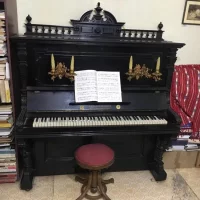
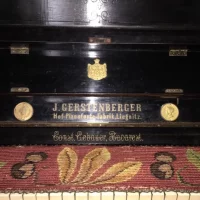
Julius Gerstenberger piano made at the Hof-Pianoforte-Fabrik factory in Liegnitz (Poland) and sold by the Constantin Gebauer store in Bucharest
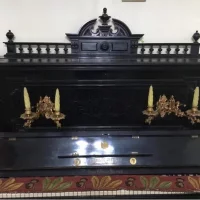
The piano is in very good condition, with a bronze mechanical plate, ivory keys – 85 pcs, 2 pedals, crossed string system, height-adjustable swivel seat, bronze lighting tips, embroidered protection over the keyboard.
The piano was awarded a bronze medal at the International Exhibition (Royal Exhibition) in Melbourne Australia in 1880 and has the insignia attesting to this fact, representing the faces of the medal obtained.
The report of juries was: “Tall instrument, high frame, great length of string.”
The obverse (front) of the medal shows the profile of Queen Victoria with crown and veil, around which is the inscription "MELBOURNE INTERNATIONAL EXHIBITION MDCCCLXXX".
The reverse of the medal shows a crown, surrounded by the Latin motto: "VITAM / EXCOLVERE / PER ARTES". ("Life develops through art").
The awards obtained is recorded in the book Official Record Melbourne International Exhibition 1880 -1881', Mason, Firth & McCutcheon, on page 237.
Also, as a guarantee of quality, the shop of Constantin Gebauer, distributor of the J. GERSTENBERGER piano, was the "supplier of the Romanian Royal Court" in the 1880’s, a sign of the quality of the trade carried out over the years. On the piano is a medal representing the coat of arms of the Royal House of Romania - the Coat of Arms of Romania under King Carol I.
C-tin's shop. Gebauer was located in Bucharest, on Calea Victoriei, at number 43.
Constantin Gebauer (b. October 18, 1846, Bucharest – d. March 9, 1920) was a Romanian businessman and publisher. He is known for opening and maintaining the first musical instrument store in the Romanian Principalities and a prestigious publishing house specialized in the sale of musical scores.
The piano was purchased in 1985 from a descendant of a well known romanian poet, St.O. Joseph.
The piano is in very good condition, with a bronze mechanical plate, ivory keys – 85 pcs, 2 pedals, crossed string system, height-adjustable swivel seat, bronze lighting tips, embroidered protection over the keyboard.
The piano was awarded a bronze medal at the International Exhibition (Royal Exhibition) in Melbourne Australia in 1880 and has the insignia attesting to this fact, representing the faces of the medal obtained.
The report of juries was: “Tall instrument, high frame, great length of string.”
The obverse (front) of the medal shows the profile of Queen Victoria with crown and veil, around which is the inscription "MELBOURNE INTERNATIONAL EXHIBITION MDCCCLXXX".
The reverse of the medal shows a crown, surrounded by the Latin motto: "VITAM / EXCOLVERE / PER ARTES". ("Life develops through art").
The awards obtained is recorded in the book Official Record Melbourne International Exhibition 1880 -1881', Mason, Firth & McCutcheon, on page 237.
Also, as a guarantee of quality, the shop of Constantin Gebauer, distributor of the J. GERSTENBERGER piano, was the "supplier of the Romanian Royal Court" in the 1880’s, a sign of the quality of the trade carried out over the years. On the piano is a medal representing the coat of arms of the Royal House of Romania - the Coat of Arms of Romania under King Carol I.
C-tin's shop. Gebauer was located in Bucharest, on Calea Victoriei, at number 43.
Constantin Gebauer (b. October 18, 1846, Bucharest – d. March 9, 1920) was a Romanian businessman and publisher. He is known for opening and maintaining the first musical instrument store in the Romanian Principalities and a prestigious publishing house specialized in the sale of musical scores.
The piano was purchased in 1985 from a descendant of a well known romanian poet, St.O. Joseph.
País
Rumanía
Estado/Región/Provincia
Distrito de Prahova
Ciudad
Ploieşti
